Wednesday, January 21, 2015

Tremendous Tenor Trombone Talk Along w/ Bass Trombone Banter

King Tenor Trombone

The tremendous tenor trombone is the most common of all the trombones. I would even say that they are the king of the trombone section. Any ways, you can find them in a classical, jazz, ska or funk band. As many musicians know the fundamental note of the tenor trombone is Bb even though the trombone is in the key of C. What this means is the first position (open position) is Bb.
Trombone Position Diagram
There are seven positions on the tenor trombone like all trombones. Since the tenor is based on the mid range there majority of the positions used are within 6.  The usual range of a tenor trombone is from a pedal Bb to a high Ab.  
Tenor Trombone Musical Range 
  Since the tenor trombone is the most common trombone in bands there's lots of music where the tenor trombone breaks the limited range here. For example There's Andy Martin one of my favorite trombonists that loves to go out of the range. Here's one video of his work Posted by Rob Egerton


Straight Tenors are not typically used in the context of classical bands. This is mainly for the smaller bore size provides a brighter tone quality which is better for a jazz setting.

Next is the f-attachment tenor trombone, the type of trombone I personally own. 
F-Attachment Tenor Trombone
What the f-attachment does is lowers the pitch of the fundamental note from Bb to F. The Trombone includes a trigger to enable this change to occur. The bore size(width of tubing) is larger in an f-attachment trombone and can be 0.525" or 0.547" compared to the bore size of a tenor trombone which can get into the 0.4"'s The reason that most people have f-attachment in classical bands is so that there is more of a supported and deeper tone while allowing for a lower range, alternate positions and more in tune notes. 

Next is the lovable Bass Trombone. 
Bass trombone
 It seems than next year I will be playing fourth trombone in
the varsity jazz band which involves the glorious
bass trombone. The low end of the trombone line-up, but not the lowest. The typical bore size of a bass trombone is 0.562" or 0.580" with the bell size being bigger than the f-attachment trombone and even bigger than the straight tenor. This allows for a greater dispersal sound. This is why there are straight tenors in jazz band for bright and directed music except for fourth trombone of course. I shouldn't say this again, but, this is why there are f-attachment trombones in classical bands along with bass trombones. To discontinue my ramblings, please make sure to comment and vote on which instrument in truly the best. Thanks for reading, if you made it all the way through, then you will definitely get a trophy... within 7 to 2700 years. Have a good day, a good night and everything in between. P.S. heres this 15th century bass trombone.

Friday, January 16, 2015

A Jazz Time Table

Alright, This time I'll talk about the history of Jazz where it started where it came from and who was at the forefront of a specific jazz movement. So lets get started.

Tommy Turpin, Image Courtesy of Flag Music
So, when slave were in the field they needed pass time and something that was their own. They started the sing and sing back songs, this was the start of the blues. After the abolishment of slavery jazz started to develop.  In 1892 the first ragtime composition known was made by Tommy Turpin called Harlem Rag.  Ragtime was the first development of early jazz.

Now actually getting into the 20th century in 1902 the John Philip Sousa Band records the ragtime piece Trombone Sneeze. Also in 1902 Lincoln Park is opened in New Orleans as a center for ragtime jazz.
John Philip Sousa Band, Image Courtesy of Britannica

In 1913 the word "Jazz" first appears in print at the same the tallest building in the world is built at 60-floors. In 1917 The Original Dixieland Jazz Band make their first jazz recording, and yes that is how it is spelled. This happened as the US entered into World War I.
The Original Dixieland Jazz Band, Image Courtesy of  Wikimedia

In 1922 the pianist Fats Waller makes his first recordings as well as "Count" Basie. Also in the same year  Louis Armstrong moves to Chicago to join King Oliver's Band.
"Count" Basie, Image Courtesy of Rovicorp
Louis Armstrong, Image Courtesy of TheFamousPeople.com

Fats Waller, Image Courtesy of Wikimedia

In 1924 Duke Ellington makes his first recordings as the leader of the Washingtonians. In 1926 Louis Armstrong pioneers scat  singing with the song Heebie Jeebies with his Fat Five. John Coltrane and Miles Davis were born.

In 1933 Singer Billie Holiday makes her first recording. In 1937 Dizzy Gillespie does his first recording.


Billie Holiday, Image courtesy of FanArt.tv

In 1939 a new band led by trombonist Glenn Miller gains game through regular radio broadcasts. In 1943 Charlie Parker and Dizzy Gillespie join pianist Earl Hine's band. Thelonious Monk makes his first recordings with the Coleman Hawkins Quartet. In 1945 Dizzy Gillespie records Be-Bop. After this Parker hires Miles Davis to replace Gillespie at the Three Deuces on 52nd Street. Charlie Parker and Dizzy Gillespie play in LA trying to get people to gain an interest in Be-Bop. In 1947 Miles Davis Records for the first time as a lead. Dizzy Gillespie records Manteca, bringing attention to Afro-Cuban Jazz.

Basically a lot of bad things happened and also in 1957 Miles Davis records Milestones, featuring early modal jazz. This is about all the important stuff in the timeline. If you would like to get events or go on in jazz past the 50's  its all right here. Thanks for reading guys for reading. If you made it all the way through they you get a gold star. Talk to you guys next post.

Thursday, January 15, 2015

Taking Every Opportunity To Get Better

Today, this post is going to be all about why you should get private lessons. So, lets get into my personal reasons.


Young Trombone Shorty

Trombone Shorty Today
       Alright so If you know trombone shorty you know that he's been a good player for a while. He played with Wynton Marsalis, Wycliffe Gordon and a number of other jazz professionals in the Lincoln Center Jazz Orchestra at age 13. But the reason I'm using this comparison is to show your growth as a musician if you take private lessons. Now you getting better doesn't only consist of you taking lessons. When you are around people that are better than you at something you are bound to get better yourself. Before I continue I just want to make clear I don't expect whoever's reading this to be at the level Trombone Shorty was at age 13. I purely just want to show you what can happen when you get better. Now lets go over what you can do to get better.

First there is Marching Band. Your college and high school are filled with lots of upper-class men that are better than you just hanging out with them can make a difference. With marching band there's a schedule that you have to follow for me it was every week day at 7:30 am until we the directors thought we were done for the day. Either way you get in at least two hours of hanging out with people that can teach you a thing or two. By the end of the summer I was twice as good as I was when school let out.
Nebraska Cornhusker's Marching Band
Next are combo groups. So with a combo group there aren't five or more instruments just like you to cover your mistakes. Usually there is only one trombone, one or two trumpets, one french horn and so on so you are completely liable for any mistakes you make. This forces you to practice just because of peer pressure. Also it allows you to hear what a tuba part actually sounds like and you can actually delve into what makes each instrument in your group so special.

Brass Quintet
Lastly are private lessons. Getting a private instructor is probably the best way to improve the fastest. A private instructor nit-picks at the stuff that you don't address. They can find the problems with your playing that you didn't even know about and help you fix those problems.  Your private instructor can pick out music for auditions and help you with them so you can perform the best you can. Taking private lessons can make you so much better. For me personally my tone quality,  my breathing, articulation, even how I hold the instrument has improved and I didn't know I was doing it wrong. Overall taking private lessons, marching band and joining are getting together combo groups. They will all help you more than you think they will. If you want to be a better player all these things will guarantee you success. 

Saturday, January 10, 2015

Whimsical Warm-Ups

This week's post is going to be all about warm-ups. We will be talking about the ins, outs, in-betweens and need to knows of warm-ups. So sit back and take some mental notes if you don't have a pen and paper.
Kid Warming Up On Mouthpiece

Brass Players Warming Up


Ok, so lets go over the start of the warm-up. You can either warm up with your mouth piece in your instrument or you can warm up with your mouth piece alone. The pros for warming up with up with your instrument are: your mouthpiece and your instrument are warmed up at the same time, you can tell the tone quality of sound you are producing. The cons are that its harder to produce a good sound. The pros of warming up on a mouthpiece first is that you can produce a better sound on your instrument. It's easier to play on your instrument afterward. The cons are you are only warming up on the mouthpiece, and you sound like a bee when you do it. I personally just warmup with my instrument and mouthpiece, mainly because I rush to get warmed up so I can work on things before we have to tune.


Now that you know what to choose when you are warming up lets actually talk about what to do when you warm up. When you first pick up your instrument or mouthpiece you should play your tuning note. Support your sound and play a Concert F if you are warming up for classical music and a Concert Bb if you are warming up or tuning for Jazz Band. So after you play F or Bb you go down a whole step until you are a partial lower than you started at.

After this you want to to some quarter note lip slurs. You will want to start out at low Bb or open fingering and go up by a partial until you are an octave higher than when you started and then you go back down in the same manor. When you are doing this make sure that you aren't articulating, its important to keep a loose embouchure when you are doing this. Like last time go down a whole step until you are a partial lower than you started.

Bb Scale 
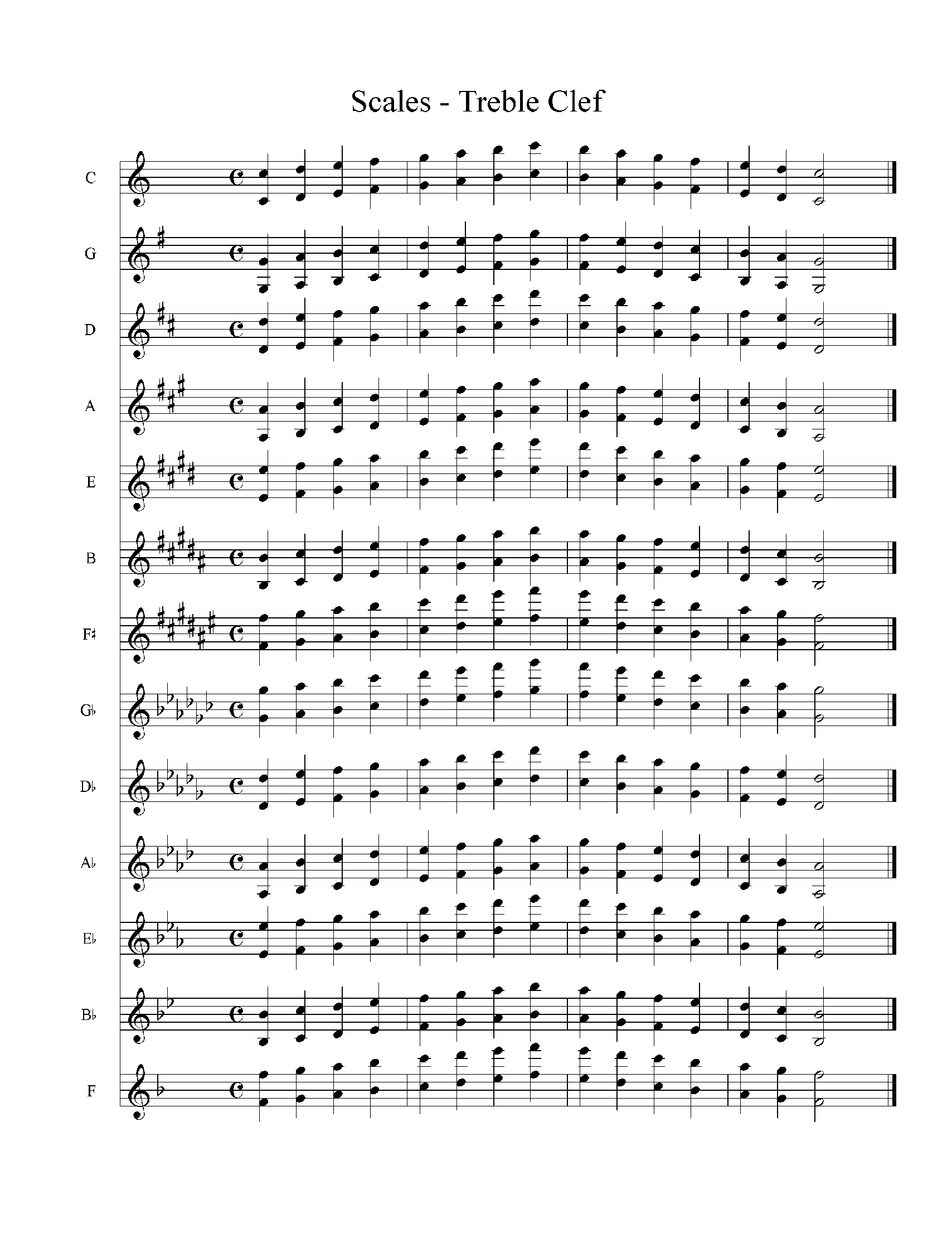
Lastly is scales. So you are going to need a scale sheet for this. Usually you just go through all the Major Scales and then you can just carry on with what you want to do. These are the scales that you are going to want to play.
Bass Clef Major Scales

Treble Clef Major Scales

That's Basically all you need need to know about warm-ups in this post. Sorry if it got boring, I'll try and make it more interesting next post. Talk to you guys next post.


Friday, December 19, 2014

Mutes for Music: The "Wa Wa" Edition


Alright, I'm  starting another post yet again with alright! Now in this continuation of mutes for music the "Wa Wa" edition we are going to be talking about mutes that you can "Wa Wa" with, even though that sounds weird. Anyway lets get started.


Now lets talk about the harmon mute otherwise know as the "Wa Wa" mute. If you'll excuse all the alright's in this post you'll find out that yes, this is another jazz specific mute! The reason for this is that jazz is reigns superior or classical, but that's all I have to say about that. But, not about the harmon mute. The harmon mute is a two part mute. The first part is almost a mold of your bell and the second part is call "the stem" I don't know why, maybe a bunch of mute inventors were around a flower field and got their idea for the harmon. Pardon the utter randomness and Here's how it sounds. If you need help please refer to the underlined section above. Now even though it sounds like he's playing classical music at the beginning he it turns to jazz because you can't deny jazz man/woman, you can't. Oh I almost forgot you call it the "Wa Wa" mute because when you take out the stem, cup your hand in front the bell and move it in and out while you play it sounds like "Wa Wa". Next is the plunger mute.


Lastly is the plunger mute(it also "Wa Wa"'s). Now I'm going to show you a very awesome brace yourself for "the incredible, the invincible, awe inspiring, the amazing, bunch of other 1980's WWF introductions". Wycliffe Gordon! Now after witnessing that amazingness you can see why my favorite is the plunger. It can double as a toilet pumper and a "Wa Wa" specialist. Just kidding that's disgusting get a new plunger from your local Walmart not your grandma's bathroom, please.


Lastly is the hat mute or the "derby" hat mute. Now the hat mute is what you get when a plunger and a fedora have kids. The Hat mute is as hard as a regular fedora that has been sprayed with liquid nitrogen. Basically a hard hat that you can "Wa Wa" with. It does the same thing that the plunger does but its purpose it have a cool visual effect.


Ok guys that's all the mutes I can tell you about thanks for reading and have a nice day and watch Wycliffe Gordon on your way out!


Mutes for Music

Bunch of Custom Straight Mutes
Hey guys today's post is about mutes. I'll talk about the types of mutes out there. Oh, and I forgot to tell you that this only applies to brass. If you haven't figured it out by now that this blog is mostly about brass.
Straight Mute
Alright lets start this post off with the fact that I honestly only own one mute. It's a Denis Wick Straight mute and I use it in my symphonic band.  That link will show you what it sounds like on a trumpet. Anyway before I go on let me tell you that mutes aren't there just to make your bass instrument look cooler. They are used to express something musically in a song. The mute changes your tone quality usually to dampen the sound. In the Straight mutes Case its job is to give the instrument a more brassier and metallic sound. Next is the cup mute.


Cup Mute
So, the cup mute. Its a straight mute with a cup on the end. The sound and tonal quality is a softer and more muffled than that of a straight mute. Heres a link to a trumpet playing a straight mute. In the video he reviews the mute and plays for you a little. If you noticed (if you are not blind of course) this is a different guy in this video. The person playing the straight mute in the first was having too much trouble actually playing the instrument to be able to show off the what the mute. This was especially true in his cup  mute video, so you won't be seeing anymore of him. So if you also noticed that the man was playing jazz you have a good ear. The reason he plays jazz in the video is because the cup mute is more geared for jazz. I am yet to see a classical piece with cup mutes but maybe I just don't play the classical music that uses them. But don't forget Straight mute is for classical and cup mute is for jazz.
Bucket Mute


Next up is the bucket mute. Now the Bucket mute is more of a muffler. It's not a scarf or a car part, it just muffles the sound more than the other mutes. In this video the same guy that did the last video shows off the bucket mute. Just skip ahead to the part when he has the horn on his face and press play, its ok I'll wait... . Alright by now you've either watched the video and you are critiquing my writing structure with those dot dot dots or you just kept on reading and are also critiquing my writing structure with those dot dot dots. Either or, you get the idea. This mute is also used in a jazz setting like the cup mute. I don't know what the composition of his mute was but mine has tons of cotton balls in it to make it a true muffler. Alright guys the next post is the "Wa Wa" edition and I get into the coolest mutes out there.


Wednesday, December 3, 2014

Christmas Carol Quintets

That time of year is approaching again. Yep, that's right it's the holidays and now somehow its our job to play everybody a christmas song or whatever else they want to hear. All the family will be coming over to celebrate and they've never seen or heard you play it before. "Play us a song!" they'll say and you don't know any melodies to the songs they want to hear.

I've been in that situation before. All I had was some backgrounds for some of those songs, so with my family being so geared up to hear me play I had to do improvisation for five minutes. (Good thing I was in jazz band). The solo was bad even though all my family clapped and applauded. This year I'm ahead of the curve. I bought music for a full trombone quintet to play for two concerts. Ten songs five part harmonies, the works and I couldn't be more excited. Now I don't have to improvise and I can actually play the songs that my family wants to hear. Christmas music is fun but it isn't free. You have to buy the music if you want to get legitimate copies. Sure if you go to this link you can just print the preview pages which might just be a couple of free christmas songs. Getting a group together is such a fun thing and everyone out there with an instrument should really think about doing. It gets everyone together, and is just overall a good time.
Hip Hop Trombone Quartet Crew
Look at these guys are having the time of their lives doing chamber groups. These guys could be you guys. My quintet and I are doing a rehearsal tomorrow and It's going to be great. If you want to be a better player getting into or starting a chamber group is a great idea. Also If you want to do a solo that would be a great idea as well if you just wanted to know the melody without having to worry about harmonies. Thanks for reading and I'll talk to you guys another time.