Showing posts with label Sound. Show all posts

Tuesday, February 3, 2015

Saccharine Sopranos and Adamant Alto Trombones

Hello ladies and gentlemen to the blog where you get to read alliteration filled facetious blog posts with words that are put in to make me sound smarter than I actually am. Now I realize that most of you fastidious fellows are picking up on the fact that saccharine and adamant don't go together. If you haven't noticed that, then more power to you for not being a grammar nazi. Alright I'm in a particularly happy mood so you will get to see that said mood slip down that old slippery slope inevitable depression that comes with writing about vapid trombone variations(yes, the dictionary is always open). To continue this trail of nonsense we will talk about the alto trombone. To drop some knowledge, the alto trombone is pitched in either Eb which would be a perfect fourth above the tenor trombone or F, a perfect fifth above the tenor trombone.

Alto Trombone

In this video that I can't caption, either based on ineptitude or just plain technical difficulties it shows a jazz alto trombonist featured on great come and get it day. This kind of allows you to hear what an alto trombone sounds like in the context of jazz with a brighter tone.
The times for the best tromboneness is 1:00, 3:31 and 5:54( that's a word now).

In this video there is a classical alto trombone soloist accompanied by a this menacing violin player to the right of him. Despite the scary browbeating violinist it still shows off what the alto trombone can do and what it sounds like in the context of a classical ensemble with a darker tone from the soloist.

Next as we go right along even though it may not seem like to the soprano trombone.
Soprano Trombone
Now, before you get mad at me for not supplying any video of a soprano trombone the fact is that every video I watched caused me either discomfort or physical pain just listening to them. But wait! More knowledge shall be supplied. The soprano trombone is pitched at a Bb an octave above the tenor trombone. Since this is the case most band leaders have trumpet players play the soprano trombone, when this occurs there is less note accuracy when the trumpeter is not accustomed to slide work. This is mainly why it is hard to find a good video of people playing the instrument. Maybe the bad sound is purely because it sounds like a trumpet. Burns that require regular icing aside There is another level above the soprano trombone. It is known as the sopranino trombone. It is pitched one octave above the alto trombone at an Eb.
Sopranino trombone
But Billy Mayes style,"Wait there's even more!" Boom shaka laka its a Piccolo trombone! It looks virtually the same but, it's octave above the soprano trombone, so guess what that's Bb again. I know we are all disappointed in that pitch of instrument, but it's a thing so we need to accept for the fantastic monstrosity it really is.

To conclude menagerie of trombone variants, I formally say now, it's not worth it to get anything above a alto trombone. Sure if you have found a trombone/trumpet player that can play the part for a specific song that can play it well, then the soprano trombone is acceptable. Honestly though, who thought the sopranino and piccolo trombone. I personally think that those would be very good as a part of a baby mobile. All joking aside thats the end of this blogpost, if you made it this far, you might get a Camaro one day.

Wednesday, January 21, 2015

Tremendous Tenor Trombone Talk Along w/ Bass Trombone Banter

King Tenor Trombone

The tremendous tenor trombone is the most common of all the trombones. I would even say that they are the king of the trombone section. Any ways, you can find them in a classical, jazz, ska or funk band. As many musicians know the fundamental note of the tenor trombone is Bb even though the trombone is in the key of C. What this means is the first position (open position) is Bb.
Trombone Position Diagram
There are seven positions on the tenor trombone like all trombones. Since the tenor is based on the mid range there majority of the positions used are within 6.  The usual range of a tenor trombone is from a pedal Bb to a high Ab.  
Tenor Trombone Musical Range 
  Since the tenor trombone is the most common trombone in bands there's lots of music where the tenor trombone breaks the limited range here. For example There's Andy Martin one of my favorite trombonists that loves to go out of the range. Here's one video of his work Posted by Rob Egerton


Straight Tenors are not typically used in the context of classical bands. This is mainly for the smaller bore size provides a brighter tone quality which is better for a jazz setting.

Next is the f-attachment tenor trombone, the type of trombone I personally own. 
F-Attachment Tenor Trombone
What the f-attachment does is lowers the pitch of the fundamental note from Bb to F. The Trombone includes a trigger to enable this change to occur. The bore size(width of tubing) is larger in an f-attachment trombone and can be 0.525" or 0.547" compared to the bore size of a tenor trombone which can get into the 0.4"'s The reason that most people have f-attachment in classical bands is so that there is more of a supported and deeper tone while allowing for a lower range, alternate positions and more in tune notes. 

Next is the lovable Bass Trombone. 
Bass trombone
 It seems than next year I will be playing fourth trombone in
the varsity jazz band which involves the glorious
bass trombone. The low end of the trombone line-up, but not the lowest. The typical bore size of a bass trombone is 0.562" or 0.580" with the bell size being bigger than the f-attachment trombone and even bigger than the straight tenor. This allows for a greater dispersal sound. This is why there are straight tenors in jazz band for bright and directed music except for fourth trombone of course. I shouldn't say this again, but, this is why there are f-attachment trombones in classical bands along with bass trombones. To discontinue my ramblings, please make sure to comment and vote on which instrument in truly the best. Thanks for reading, if you made it all the way through, then you will definitely get a trophy... within 7 to 2700 years. Have a good day, a good night and everything in between. P.S. heres this 15th century bass trombone.

Thursday, January 15, 2015

Taking Every Opportunity To Get Better

Today, this post is going to be all about why you should get private lessons. So, lets get into my personal reasons.


Young Trombone Shorty

Trombone Shorty Today
       Alright so If you know trombone shorty you know that he's been a good player for a while. He played with Wynton Marsalis, Wycliffe Gordon and a number of other jazz professionals in the Lincoln Center Jazz Orchestra at age 13. But the reason I'm using this comparison is to show your growth as a musician if you take private lessons. Now you getting better doesn't only consist of you taking lessons. When you are around people that are better than you at something you are bound to get better yourself. Before I continue I just want to make clear I don't expect whoever's reading this to be at the level Trombone Shorty was at age 13. I purely just want to show you what can happen when you get better. Now lets go over what you can do to get better.

First there is Marching Band. Your college and high school are filled with lots of upper-class men that are better than you just hanging out with them can make a difference. With marching band there's a schedule that you have to follow for me it was every week day at 7:30 am until we the directors thought we were done for the day. Either way you get in at least two hours of hanging out with people that can teach you a thing or two. By the end of the summer I was twice as good as I was when school let out.
Nebraska Cornhusker's Marching Band
Next are combo groups. So with a combo group there aren't five or more instruments just like you to cover your mistakes. Usually there is only one trombone, one or two trumpets, one french horn and so on so you are completely liable for any mistakes you make. This forces you to practice just because of peer pressure. Also it allows you to hear what a tuba part actually sounds like and you can actually delve into what makes each instrument in your group so special.

Brass Quintet
Lastly are private lessons. Getting a private instructor is probably the best way to improve the fastest. A private instructor nit-picks at the stuff that you don't address. They can find the problems with your playing that you didn't even know about and help you fix those problems.  Your private instructor can pick out music for auditions and help you with them so you can perform the best you can. Taking private lessons can make you so much better. For me personally my tone quality,  my breathing, articulation, even how I hold the instrument has improved and I didn't know I was doing it wrong. Overall taking private lessons, marching band and joining are getting together combo groups. They will all help you more than you think they will. If you want to be a better player all these things will guarantee you success. 

Saturday, January 10, 2015

Whimsical Warm-Ups

This week's post is going to be all about warm-ups. We will be talking about the ins, outs, in-betweens and need to knows of warm-ups. So sit back and take some mental notes if you don't have a pen and paper.
Kid Warming Up On Mouthpiece

Brass Players Warming Up


Ok, so lets go over the start of the warm-up. You can either warm up with your mouth piece in your instrument or you can warm up with your mouth piece alone. The pros for warming up with up with your instrument are: your mouthpiece and your instrument are warmed up at the same time, you can tell the tone quality of sound you are producing. The cons are that its harder to produce a good sound. The pros of warming up on a mouthpiece first is that you can produce a better sound on your instrument. It's easier to play on your instrument afterward. The cons are you are only warming up on the mouthpiece, and you sound like a bee when you do it. I personally just warmup with my instrument and mouthpiece, mainly because I rush to get warmed up so I can work on things before we have to tune.


Now that you know what to choose when you are warming up lets actually talk about what to do when you warm up. When you first pick up your instrument or mouthpiece you should play your tuning note. Support your sound and play a Concert F if you are warming up for classical music and a Concert Bb if you are warming up or tuning for Jazz Band. So after you play F or Bb you go down a whole step until you are a partial lower than you started at.

After this you want to to some quarter note lip slurs. You will want to start out at low Bb or open fingering and go up by a partial until you are an octave higher than when you started and then you go back down in the same manor. When you are doing this make sure that you aren't articulating, its important to keep a loose embouchure when you are doing this. Like last time go down a whole step until you are a partial lower than you started.

Bb Scale 
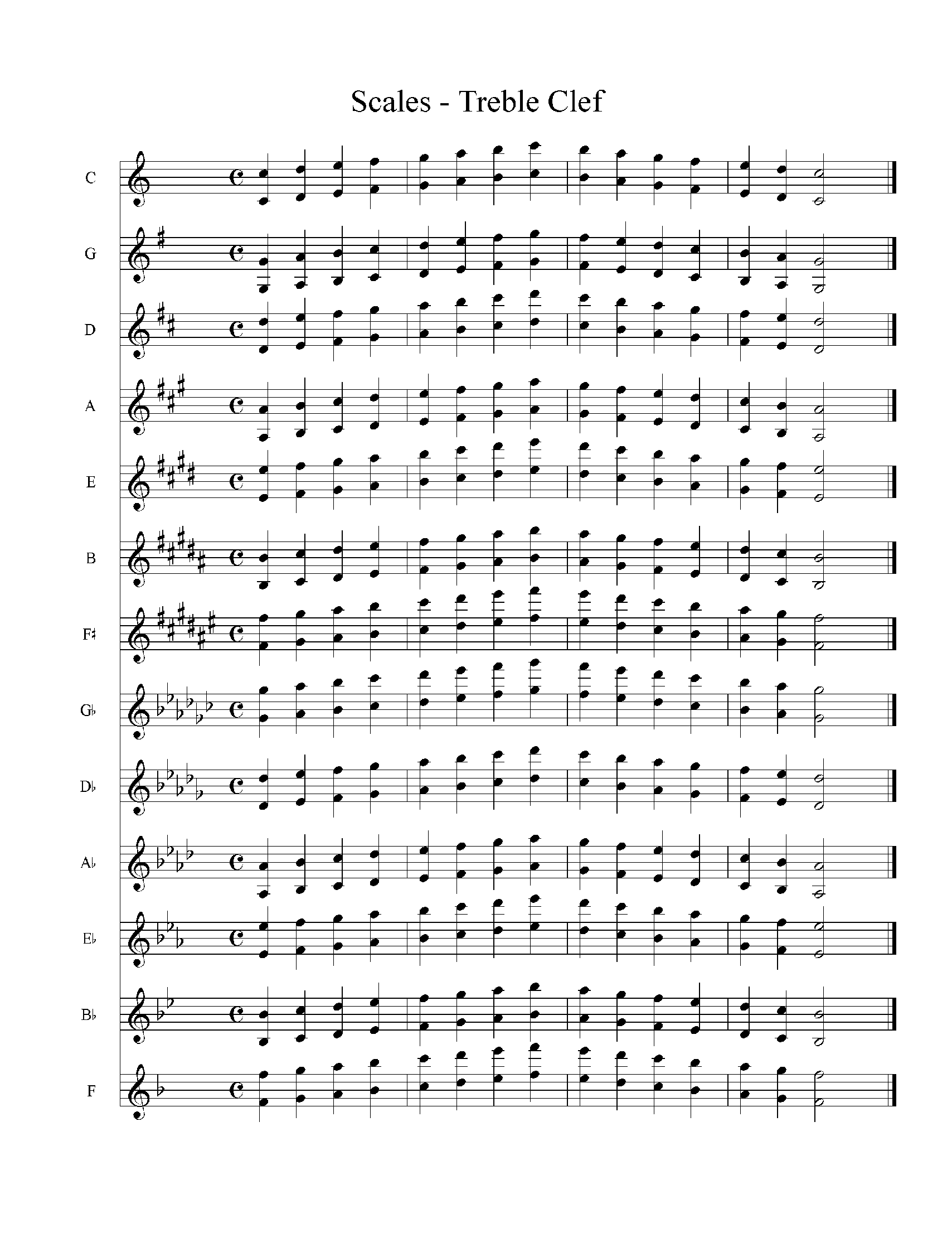
Lastly is scales. So you are going to need a scale sheet for this. Usually you just go through all the Major Scales and then you can just carry on with what you want to do. These are the scales that you are going to want to play.
Bass Clef Major Scales

Treble Clef Major Scales

That's Basically all you need need to know about warm-ups in this post. Sorry if it got boring, I'll try and make it more interesting next post. Talk to you guys next post.


Friday, December 19, 2014

Mutes for Music: The "Wa Wa" Edition


Alright, I'm  starting another post yet again with alright! Now in this continuation of mutes for music the "Wa Wa" edition we are going to be talking about mutes that you can "Wa Wa" with, even though that sounds weird. Anyway lets get started.


Now lets talk about the harmon mute otherwise know as the "Wa Wa" mute. If you'll excuse all the alright's in this post you'll find out that yes, this is another jazz specific mute! The reason for this is that jazz is reigns superior or classical, but that's all I have to say about that. But, not about the harmon mute. The harmon mute is a two part mute. The first part is almost a mold of your bell and the second part is call "the stem" I don't know why, maybe a bunch of mute inventors were around a flower field and got their idea for the harmon. Pardon the utter randomness and Here's how it sounds. If you need help please refer to the underlined section above. Now even though it sounds like he's playing classical music at the beginning he it turns to jazz because you can't deny jazz man/woman, you can't. Oh I almost forgot you call it the "Wa Wa" mute because when you take out the stem, cup your hand in front the bell and move it in and out while you play it sounds like "Wa Wa". Next is the plunger mute.


Lastly is the plunger mute(it also "Wa Wa"'s). Now I'm going to show you a very awesome brace yourself for "the incredible, the invincible, awe inspiring, the amazing, bunch of other 1980's WWF introductions". Wycliffe Gordon! Now after witnessing that amazingness you can see why my favorite is the plunger. It can double as a toilet pumper and a "Wa Wa" specialist. Just kidding that's disgusting get a new plunger from your local Walmart not your grandma's bathroom, please.


Lastly is the hat mute or the "derby" hat mute. Now the hat mute is what you get when a plunger and a fedora have kids. The Hat mute is as hard as a regular fedora that has been sprayed with liquid nitrogen. Basically a hard hat that you can "Wa Wa" with. It does the same thing that the plunger does but its purpose it have a cool visual effect.


Ok guys that's all the mutes I can tell you about thanks for reading and have a nice day and watch Wycliffe Gordon on your way out!


Thursday, October 23, 2014

Concerts

           Concerts they're the things that you work towards. They are the things that not only show your talents, but they show your flaws. Last night I had a concert with Park City's Symphonic Band and their were definitely some flaws show. The percussion I believe, did really well I didn't hear them do anything wrong. The Percussion owned the night, the rest of the ensemble did relatively well, what I depend on to know what the conductor thinks of the band is just to look at his face. Whether it's during the song or right after you will get a visual confirmation of what he thinks. Right after the last song we played was called Earth Dance he mouth the word "awesome" this is a link to what it sounds like on Youtube. Of course we were not as good as that ensemble, but we tried. I think that out of all the pieces that we played that one went the best. It was a pretty easy song in a rhythmic sense, but the real feat was maintaining tone quality and energy throughout the entire song. I'm sure it would of sounded better if we had more than three rehearsals to look at it, but we didn't have the time.
       
          So, I was not 100% happy with our performance, but the Wind Ensemble did an amazing job last night. The music was incredibly challenging and they maintained tone quality and note definition throughout their performance. Although there were some parts I could tell were extremely hard for them they powered through and made the night enjoyable. So, when preparing for a concert you have to make sure that you can play everything in the piece. If you can't then identify what's giving you trouble and work on that part, it seems pretty self explanatory, but there are lots of people that don't know how to practice and get better at their instrument.  Also It's nice to know what the piece sounds like or even have an accompaniment, so it's good to find the music that you are currently playing with your music group and match the playing of the people playing in the video or mp3 you find. If that's not the sound that the group wants then you can amend that sound to fit what your group wants.

            Also If you do base your playing off another group make sure that you fit into your group and don't over and under play, because the point of an ensemble is to make music as a group and not to be an outlier when you're making music. For example you don't want to recreate the sound exact sound of a band like this...
Dallas Millennial Choir and Orchestra 
                                                 
                                                        If you are in a band like this
Navy Band Brass Quintet
         So, find the sound that you want for your band and make sure that it matches the size and the style that the group wants. Make sure that you know your part and have it down and after all of this you can be ready for the concert.